How We Rebuilt Arrowhead’s Stadium Shade Model
See how SeatSun uses public survey data, AI builders and independent challenger agents to improve stadium shade models, starting with Arrowhead.
By SeatSun ·
If you’re choosing seats for a 3:25 PM Chiefs game, it helps to know when the stand will block the sun. Getting that answer right means getting the stadium’s shape right, too.
We’ve rebuilt our 3D model of Arrowhead Stadium, row by row, using a public aerial laser survey, seating maps and stadium photos. We’ve also changed how we check the work: AI agents build the model, separate challenger agents look for mistakes, and a person gives the final sign-off.
The rebuild changes the shade category in about one in five of the section-and-time combinations we compared. The Chiefs’ sideline gets shade earlier in our afternoon scenarios, and the club level’s exposed front rows get a closer look. Here’s what we changed and why it matters when you’re picking seats.
A closer look at the seating bowl
Our previous Arrowhead model used smooth shapes that roughly followed the stands. The rebuild has stepped rows, with the decks and overhangs fitted more closely to the measurements. Move a deck’s edge or change the height of the building behind a section, and its shadow moves too.
We also gave the review work to separate agents. Once the builder finishes, other agents check the model against the evidence and send back anything that needs fixing. Arrowhead went through that loop three times.
Arrowhead was our proof of concept. These rebuilds are fairly heavy lifts, but we expect to have all NFL and select NCAA stadiums updated by the end of 2026. Then we’ll move on to MLB and some other exciting new things.
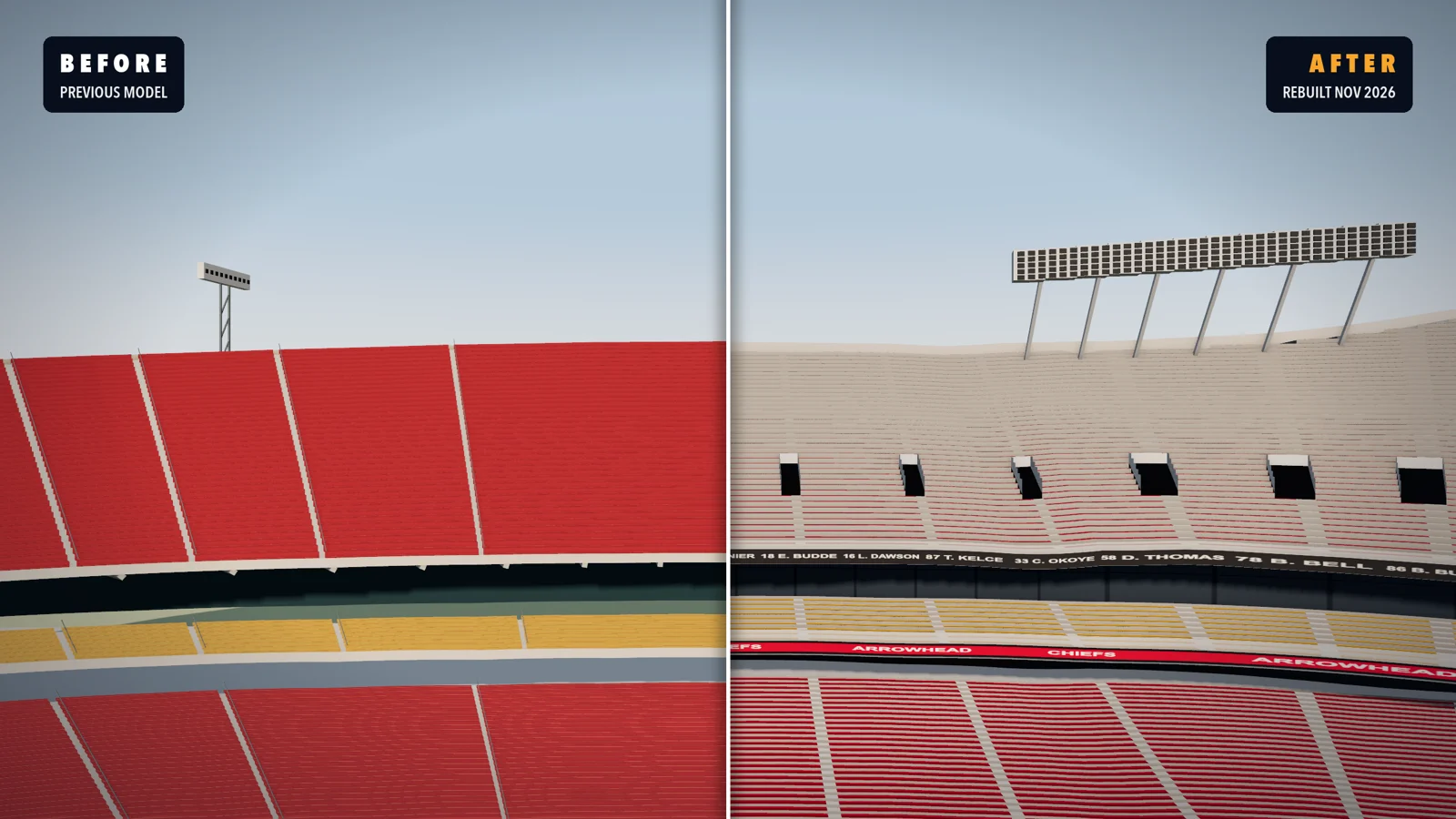
The same survey, a better reconstruction
Arrowhead’s model starts with a public USGS LiDAR survey from April 2020. LiDAR records the shape and height of surfaces using laser measurements. We used those measurements alongside aerial images, stadium seating maps, our seat-row research and photos taken from around the bowl.
The previous model used that same survey. What’s changed is how much of the stadium’s shape we’ve been able to capture from it, and how we check the result.
There are gaps in what you can measure from the air. The back of the club level sits beneath the upper deck, for example. For those hidden areas, we work from maps and photos and keep track of which parts were measured and which were reconstructed.
AI builders, challenger agents and three rounds of fixes
We use AI to research, build and review our stadium models. As the latest AI models become available, we try them on that work: can they make better sense of the evidence, build a better model or catch a mistake we’ve missed? We still check what they produce.
Our builder agent puts the stadium together. Then a separate challenger agent compares it with the photos and seating maps. It looks for things that don’t add up: an overhang in the wrong place, a seating tier that doesn’t match the photos, a structure that could be casting the wrong shadow.
Another reviewer checks for common 3D modeling problems, including gaps that let sunlight through and structures sitting at the wrong height. We fix the findings, verify the fixes and send the model back through review. A person reviews and signs off on the result.
For Arrowhead, the reviewers found 13 significant issues in the first round. After fixes, they found two. In the third round, neither found a significant issue. Those first two rounds are a big part of why we do this: they gave us specific problems to fix before the model was approved.
Why the shape of the stadium matters for shade
For a given date and time, the 3D model checks whether the stadium blocks sunlight from reaching each section. We repeat that calculation through the game to show how shade moves across the seats.
At Arrowhead, the Horizon level block above the Chiefs’ sideline makes a difference. We rebuilt its curved footprint and overhang, put the club level beneath the upper deck as its own tier, and improved the video boards and other permanent structures. Each of those shapes can affect where a shadow falls.
Section 118 gave us a clear example of an old error. For an October 18 game starting at 3:25 PM, the previous model briefly flipped the section from full shade to full sun late in the afternoon. The sun was low behind that section’s own stand. The rebuilt model keeps it shaded through the game in that scenario.
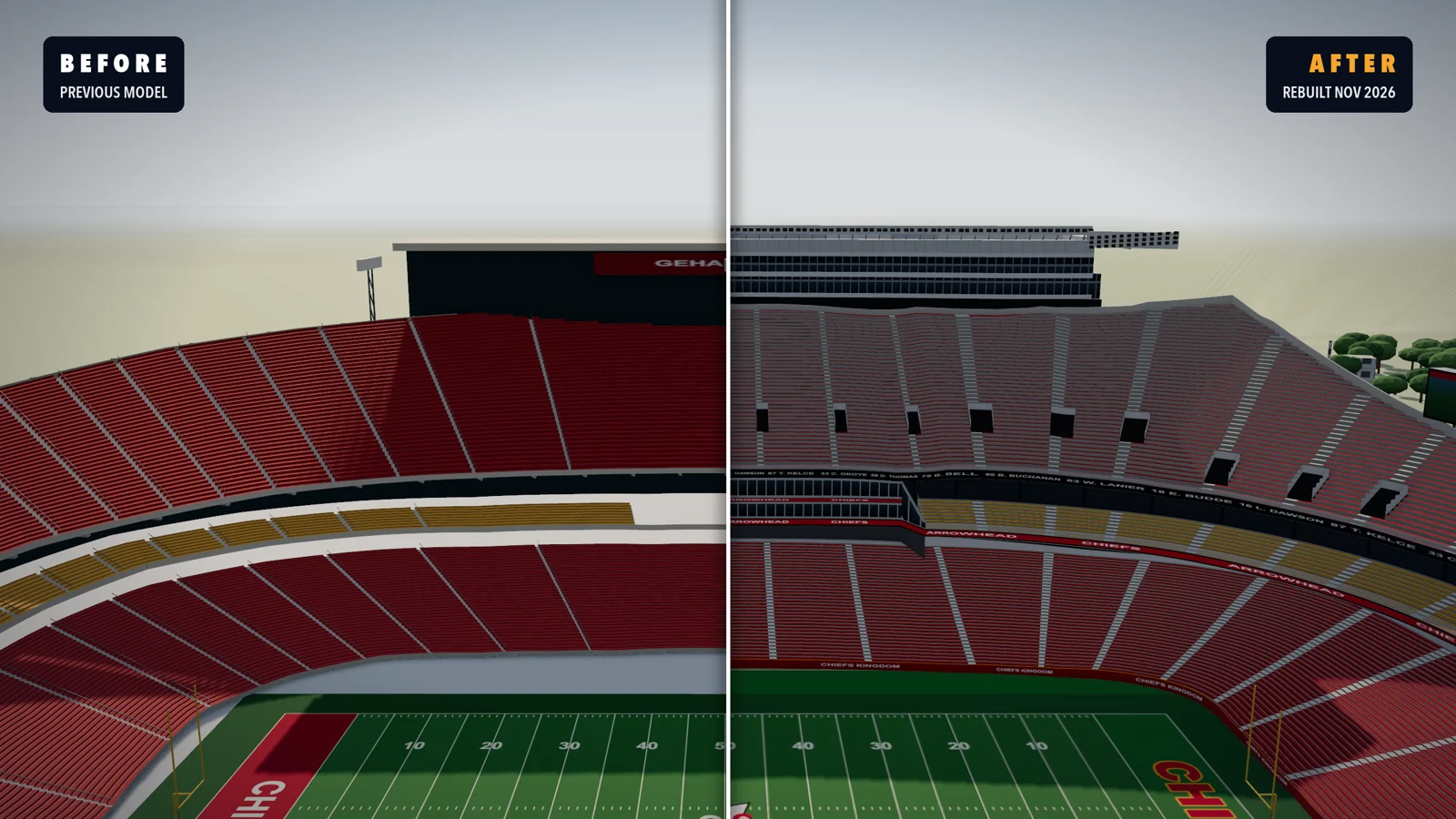
What changes for fans at Arrowhead?
For afternoon games, our rebuilt model generally shows more shade on the Chiefs’ sideline. The visitors’ upper level is still the sunny side for much of a day game.
The club level needed a correction in the other direction. Its front rows aren’t all under a roof. On the visitors’ side, those exposed rows get more midday sun than our previous model showed.
Across the comparison, 2,461 of 11,070 daylight section-times changed shade category, or 22%. A section-time is one section checked at one moment. That tells us how often the answer changed; it doesn’t measure how much more accurate the model is.
| Seating area | Kickoff group | Previous model | Rebuilt model |
|---|---|---|---|
| Chiefs’ sideline, field level (116–122) | 3:00 / 3:25 PM | 71% | 92% |
| Chiefs’ sideline, upper level (319–328) | 3:00 / 3:25 PM | 81% | 97% |
| Visitors’ side, club level (201–205, 241–246) | Noon / 1:00 PM | 27% | 19% |
Percentages describe the average share of the modeled seating area in shade across the sampled daylight times, from kickoff through four hours later. They are not the percentage of game time that an individual seat stays shaded. The comparison covered 19 kickoff scenarios using seasonal dates and the 2026 home schedule, sampled at 30-minute intervals. All times are local to Arrowhead (Central Time).
Watch the shade move across Arrowhead
This is what a day looks like in the rebuilt model. The timelapse runs from 11:00 AM to 6:30 PM Central Time on October 18, 2026. In the Sun & shade view, gold marks sunlit seating and blue marks structural shade. Uncolored surfaces keep their usual model materials.
Use our Arrowhead shade tool to check your own game date and kickoff time. The shadow you see here on an October afternoon won’t be in the same place for every game.
Checking the shadows against game-day photos
A useful check is a photo taken at a known time: does the model put the same section in sun or shade? For Arrowhead, we made 30 section checks against timestamped photos from the October 22, 2023 Chiefs game. All 30 matched.
That gives us evidence for those sections at those times. There’s still more to check across other dates and parts of the bowl. We also tested whether using more sample points would change the shade category. It didn’t in the 112 cases we tested.
Once a model is approved, automated checks flag unintended changes while we work on other stadiums. We can come back and improve Arrowhead again, but those changes need their own review.
What to keep in mind when using the shade map
The model estimates the shade cast by the stadium under a clear sky. It works at section level, so front and back rows can have different conditions. It doesn’t account for clouds, temperature, flags or temporary structures.
The 2020 survey also predates the later front-row risers, World Cup field changes and the 2024 lighting upgrade; those aren’t incorporated in this rebuild. Where the shade answer is a close call, the site labels it Borderline.
Your section numbers and existing links still work. Open the Arrowhead map, choose your game, and compare the shade view with the section’s row-cover notes before you buy.
We hope to keep adding features and improving accuracy over time, perhaps even bringing live weather estimates into the picture. For now, this model focuses on the shade the stadium itself provides.
Frequently asked questions
How does SeatSun calculate stadium shade?
For stadiums with a 3D model, SeatSun calculates where the sun is for your date and time, then checks which parts of each section the stadium shades. That gives you a section-level estimate of structural shade. It doesn’t account for weather or guarantee shade at an individual seat.
Does SeatSun use AI to build its stadium models?
Yes. We use AI for research, building and review. Separate challenger agents look for mistakes, fixes go through another check, and a person signs off. The shade estimate itself comes from the stadium geometry and the calculated position of the sun.
Which side of Arrowhead gets more shade for a 3:25 PM game?
The Chiefs’ sideline generally gets more shade in our rebuilt afternoon scenarios. The visitors’ upper level stays in sun for much of a day game. Check your date and section on the map, since the pattern changes through the season and during the game.
Are all club-level seats at Arrowhead covered?
No. The club level sits beneath the upper deck, but its front rows are exposed. Cover depends on the section and row, and low-angle sun can reach under an overhang. Read the section’s cover notes alongside the shade view.
Does the 22% change mean the model is 22% more accurate?
No. The 22% describes how often the shade category changed when we compared the two models at the same sections and times in daylight. To check accuracy, we use separate evidence, including survey measurements and timestamped photos.
Is this based on a new laser survey of Arrowhead?
No. Both versions use the same public USGS survey from April 2020. We’ve rebuilt the stadium to fit that survey more closely, filled in hidden areas using maps and photos, and added independent review and repeat checks.
Can SeatSun guarantee that my seat will be in shade?
No. The map estimates structural shade across a section under a clear sky. Your row can make a difference, and weather or temporary changes aren’t included. Use the map together with the row-cover notes, and look out for the Borderline label on close calls.